Rules
Part of Part-time ideas: what beginners should know
Part-time ideas guide: practical steps for better results
Part-time ideas guide: settling the employer question, matching work to the hours you really have, building for a bad week, and when to reconsider full time.
A part-time venture is not a small full-time one. It has a different shape, because the constraint is not money or skill but a fixed number of hours that arrive in awkward places and can be taken away by the rest of your life without notice. This guide is organized as a sequence: what to settle with your employer, what to build in the hours you have, how to run it so the two lives do not collide, and how to decide whether it should ever become the only one.
What to take away
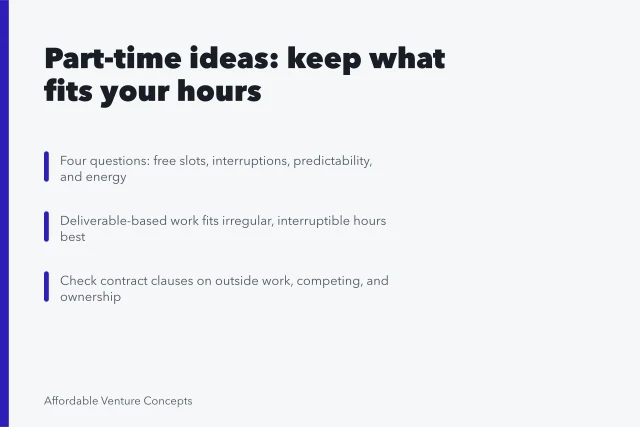
- Settle the employer question before the idea, because a contract clause can end the plan and a conflict of interest can end the job.
- Build something that survives a bad week: work that can pause, customers who can wait, and a promise you can keep at your worst.
- Decide in advance what would justify going full-time, in terms of demand and time rather than a figure, so that the decision is made by evidence rather than by fatigue.
First, the job you already have
Read your employment contract for three things: any clause on outside work or second jobs, any clause on who owns what you create, and any non-compete or confidentiality terms. Some contracts forbid outside work outright, some require permission, and some are silent. The intellectual property clause matters more than people expect: if you build something on an employer's equipment, on its time, or in its field, it may be theirs. The US Copyright Office's plain account of what copyright covers and who holds it is a useful thing to have read before a contract tells you what you agreed.
If permission is required, ask for it in writing and describe the venture honestly. If the venture competes with the employer or serves its customers, stop and think, because the cost of being wrong is the salary you are relying on. Tax also changes: a second income is reported in most systems and may be taxed differently, so check with your tax authority before the first payment arrives, not after the year ends. The IRS center for self-employed taxpayers gives a sense of what a second income adds to a return in one system.
Then, the shape of the hours
Write down the hours you actually have, then remove the ones that vanish when work is busy, a child is ill, or the shift pattern changes. What remains is the venture's real capacity, and it is smaller than the first number. The part-time pillar treats this as the starting point, and it is worth doing before choosing an idea rather than after.
Now match the idea to the shape of those hours, along three lines:
| Your hours are | Suited to | Poorly suited to |
|---|---|---|
| Fixed and predictable | Appointments, lessons, regular visits, anything booked in advance | Nothing in particular; this is the easy case |
| Free but interruptible | Writing, editing, admin, making things in stages, selling goods | Anything that needs an unbroken stretch or a live customer |
| Unpredictable from week to week | Work with long deadlines, batch production, selling from stock | Anything with a promised response time or a fixed slot |
The row you sit in decides the kind of promise you can make to a customer. A promise you can only keep in a good week is a promise you will break.
Build for the bad week
Three design rules keep a part-time venture alive through the weeks the day job takes everything.
Work that pauses. Choose tasks that can stop mid-way and resume a week later without loss. Made-to-order goods, long-deadline projects and stock that waits are all forgiving. Live services are not.
Customers who can wait. Say what your reply time is, in writing, and make it one you can meet at your worst. The local service pillar explains why fast replies win bookings; if you cannot be fast, be reliable, and sell to people who value that.
Admin that fits in the gaps. Quoting, invoicing and records done from a phone in ten-minute pieces, not on a laptop that needs an evening.
Keep the two lives apart
Separate money from the first payment: a different account, so that the venture's health is visible and the household is not silently funding it. Separate tools and devices from the employer's, without exception, because of the ownership clause above. Separate time visibly: a place, a start and a stop, so that the venture does not spread into sleep and the job does not spread into the venture.
The home-based pillar covers the physical side of that separation in detail, since most part-time work happens at home and inherits all of a home's boundary problems.
Test cheaply, in the time you have
A part-time venture cannot afford a long build. Its first months should be spent finding out whether anyone will pay, using tests that fit in an evening: an offer described on one page, a small batch, a single paid job for a friend of a friend. The point is to spend hours on questions that have answers rather than on a product nobody has asked for.
When the venture asks for more
At some point there is more demand than hours. The options, in order of reversibility, are: raise the price, decline work outside a narrower offer, buy time by paying someone for a task, and only then cut hours at the job. Each step is a test of whether the demand is real at a higher price and a narrower scope, and most ventures find their level at one of the earlier steps rather than the last.
Deciding whether to go full-time
Set the conditions now, while it is hypothetical. Useful ones are about demand and time rather than money: work turned down repeatedly for lack of hours, customers returning without being asked, a waiting list that survives a price rise, and enough saved to live on through the gap that the startup budget guide describes between doing the work and being paid for it. If those conditions arrive, the decision has been made by evidence. If they do not, the venture is a good part-time business, and that is a fine thing to have.
Common questions
Do I have to tell my employer?
Read the contract. If it requires permission or notification, yes. If it is silent, telling them is often still wise where any overlap exists, because discovery is worse than disclosure.
What if my hours change every week?
Choose work with long deadlines and no live element, and sell reliability over speed. The third row of the table is yours.
Is a part-time venture that never grows a failure?
No. Many of the best ones are designed to stay small, and a venture that pays for itself in a few hours a week is a success by any sensible measure.