
Guides
Retreat Center Operators Planning a Venture: Four Steps
Retreat center operators planning a venture can use four decisions to choose a structure, write a revisable plan, start small, and set review dates.
What to take away
- Choose an entity before the first booking. It affects your tax filing and liability, and can affect which funders will consider you.
- Write a plan short enough to revise. A long one gets filed and never opened.
- Open with the smallest offer a real guest will pay for, and add capacity only when you turn people away.
- Put four review dates in the calendar now, each with one question attached.
- Keep one week a year empty for maintenance, and treat it as booked.
Retreat center operators planning a venture can use this as a worked example. Affordable Venture Concepts covers business ideas you can start at a range of budgets and lifestyles. A retreat center is one of them. It can begin as a small site with a few beds, a rented kitchen, or a single program, then grow only as guests pay.
The four steps below cover structure, planning, sizing, and review dates. For a retreat center, they also account for lodging, food service, land use, guest safety, and seasonal cash flow.
Read the retreat center as a worked example, then swap in your own place, skill, or space.
Step one: choose a structure and handle state filings
The IRS lists the entity options in its overview of business structures: sole proprietorship, partnership, corporation, S corporation, and the limited liability company your state statute allows.
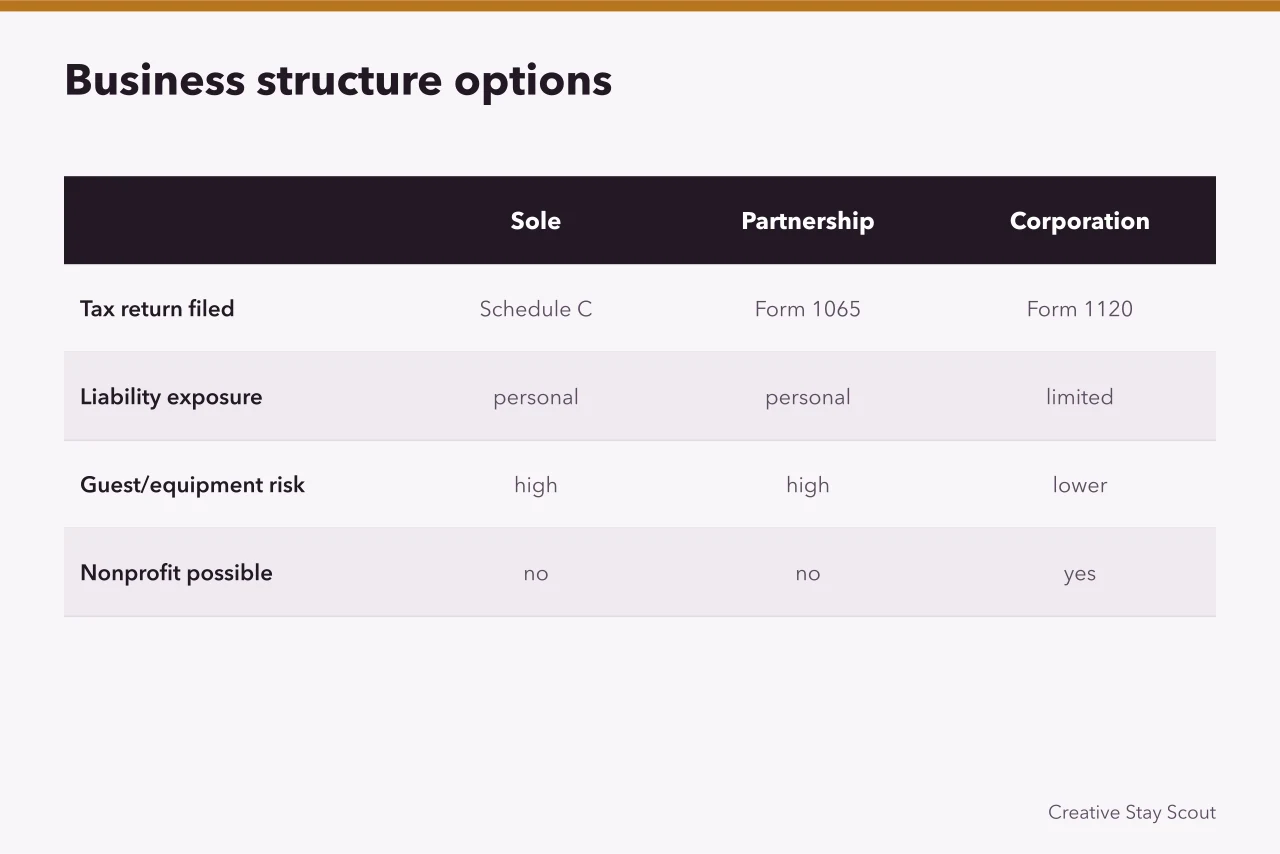
Federal tax forms depend on the entity and its tax classification. A sole proprietor generally reports business income on Schedule C; a partnership files Form 1065; a C corporation files Form 1120; and an S corporation files Form 1120-S after electing that tax treatment on Form 2553. An LLC’s federal return depends on its tax classification, not just the LLC label, so confirm the filing obligations with the IRS and a tax professional.
For state formation, check the filing rules where the retreat center will operate. States commonly require an LLC to file Articles of Organization and a corporation to file Articles of Incorporation. Ask the state business-filing office, often the Secretary of State, about the filing fee and registered-agent requirements; both vary by state.
The IRS notes that legal and tax questions both bear on the choice, which is why a lawyer and an accountant make it with you rather than a web page. For a retreat center, assess guest and equipment liability and whether a nonprofit model fits the operation. Federal tax-exempt status is not automatic: an organization seeking recognition under section 501(c)(3) generally applies to the IRS using Form 1023. Nonprofit status does not guarantee grant funding.
Step two: a plan short enough to use
The Small Business Administration's piece on business plan myths that hurt businesses opens with the correction that matters: a plan does not have to be long, and length is not quality.
The SBA also describes traditional and lean startup business plan formats. Choose the format that fits the level of detail you need, then make the retreat-specific assumptions explicit: what the site can host, when it can operate, and which services it will provide.
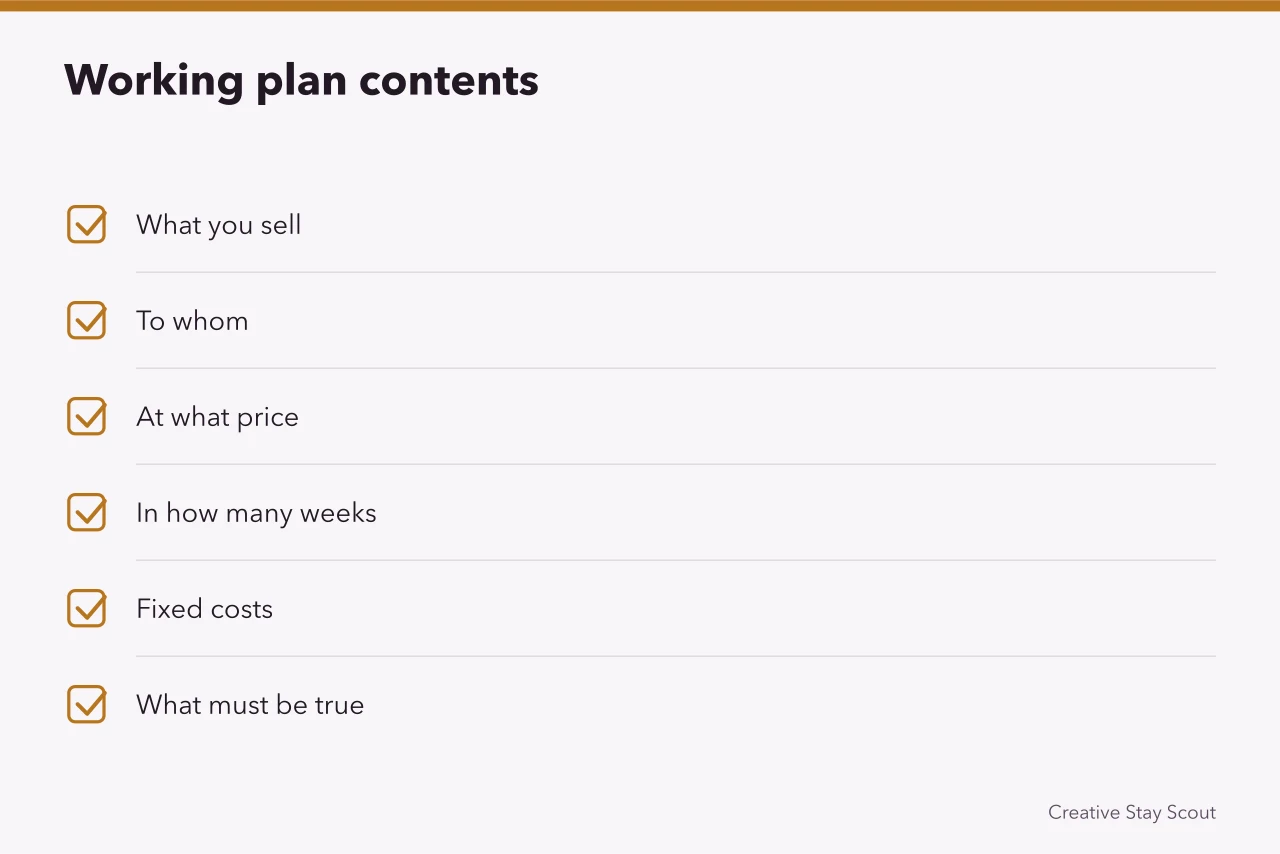
A working plan for a retreat center fits on a few pages.
What you sell, to whom, at what price, across how many weeks, against what fixed costs. Then one line: what would have to be true for this to work.
Everything else is supporting detail and belongs in a folder, not the plan.
Retreat-center budget worksheet
Use this worksheet to gather local quotes and your own operating assumptions; it is not a universal cost estimate.
- One-time startup costssite deposit or purchase, renovations, beds and furnishings, kitchen equipment, permits, and professional services.
- Fixed operating costsrent or debt payments, insurance, utilities, base staffing, and routine maintenance.
- Variable costs by guest or programfood, cleaning and laundry, supplies, payment processing, and instructors.
- Revenue assumptionsprice by stay or program, sellable guest-nights or sessions, and operating weeks.
For each offer, calculate contribution per guest by subtracting variable cost per guest from the price. Compare fixed costs with the contribution to estimate the bookings needed to break even, using quotes and assumptions for your site.
Step three: start small and check site requirements
- Open with one offer a real guest will pay for.
- Run it a full season before adding a second.
- Add beds only when you are turning people away, not when you hope to fill them.
- Hold one week a year for maintenance and defend it.
Before accepting bookings, check with the city or county planning and zoning office whether lodging and group uses are allowed at the site and whether conditional-use approval is required. Ask the state or county lodging regulator about any lodging license, the local health department about a food-service permit if you serve meals, and the local fire marshal or fire department about fire inspection requirements. Requirements depend on the location and services, so verify them with the authorities responsible for that site.
Ask an insurance broker to review commercial general liability and property insurance, and workers’ compensation if you have employees. Confirm whether your general liability coverage includes guests and program participants or whether separate participant liability coverage is needed for your activities.
The failure pattern is predictable. A center adds a teaching program, a cafe and an event space in one year, and none of the three earns a reputation.
The counter-pattern holds just as well. A site known for one thing gets talked about, and the talk does the marketing. The quietest place in the county fills its off-season without an ad budget, because the people who need quiet tell each other where to find it.
Step four: set the review dates now
Book four dates in the next twelve months, one question each. Spring: is the season filling as expected. Mid-season: what is costing more than planned. End of season: which weeks earned and which did not. Winter: what changes next year.
An hour on each date beats a weekend of planning in one sitting, provided you keep the notes in one running document.
Use the retreat-center budget worksheet in the plan to compare actual bookings and costs with your assumptions. Update it as the season unfolds, then use the results to decide what changes next year.
Common questions
Do I need a formal business plan for a small site?
A lender will ask for one. For your own use, a short working plan that gets revised beats a bound document that gets shelved.
When should the structure be decided?
Before the first booking, and with professional advice. Changing entity after you have deposits, staff and a lease costs more than deciding early.
How long should the plan take to write?
A working version in a day. If it is taking a month, you are writing the wrong document.
What if the season underperforms?
Change one thing, not five. Change five and you will never know which one worked.