Rules
Part of Which pressures shape a students' venture: permission, calendar, contracts
Which student venture tools actually survive graduation and cost cuts
Student venture tools that outlast graduation and budget cuts, judged by ownership, export, and what happens when the student account closes.
The tools that survive a degree are the ones you own outright: a domain, a payment account, a customer list in a file. Everything tied to a student email or a campus licence has a known end date, and the week after graduation is when you find out which list you were on.
What to take away
- A domain and a payment account registered in your own name are the two purchases worth making before the first sale.
- Stripe, Square, Wave, and PayPal all run free to start and charge per transaction, so the cost scales with revenue instead of arriving as a monthly bill.
- Notion, Airtable, and Google Sheets all export to CSV or Markdown, which is the test that matters when a student licence ends.
- Anything sold through a course, a society talk, or a commission link deserves a look at the FTC Business Opportunity Rule before you pay.
- Run the venture from an address you own, because password recovery dies with a university inbox.
The tools, by the job they do
Getting paid. Stripe and Square both charge a per-transaction percentage with no monthly fee at the entry tier, which suits a venture earning under a few hundred dollars a month. Wave is free for invoicing and payments in the US and Canada, funded by its accounting add-ons. PayPal remains the fastest route to a link a customer already trusts.
Holding the customer list. Google Sheets is free with any Google account, exports to CSV, and outlives every tool you will migrate to. Airtable adds views and linked records on a free tier capped by record count. Notion holds notes and a lightweight CRM on one free workspace, and exports to Markdown and CSV.
Showing what you sell. Carrd hosts a one-page site for a few dollars a year. GitHub Pages and Cloudflare Pages host static sites free, both on a domain you register yourself. Squarespace and Shopify start around a monthly subscription, which is the wrong shape of cost before revenue exists.
Scheduling and design. Calendly's free tier covers one event type. Canva's free tier covers most student work, with a Pro upgrade that is only worth it once a client is paying for the output. Both are conveniences, not foundations.
The online business pillar covers why a page on your own domain behaves differently from a profile you rent, and the same logic applies down this whole list.
What is borrowed and what is yours
Borrowed items include institution software licences and campus network access. You also get lab and workshop equipment. Student rates on subscriptions are included too. You receive an email address ending in your university's domain. Storage attached to a student account is part of it. Each item disappears on a date you can look up.
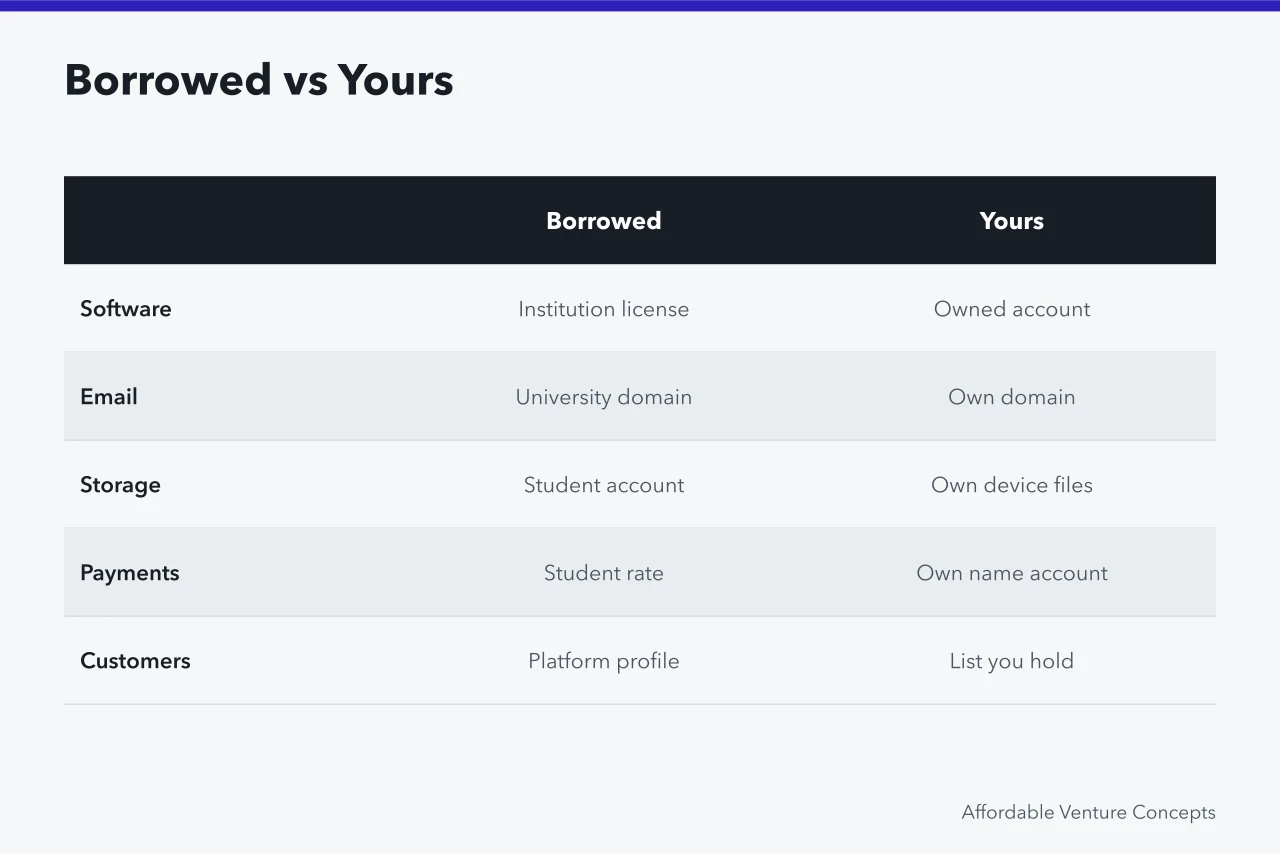
Yours: a domain registered in your own name, a payment account in your own name, records exported to files on your own device, a customer list you hold. That second list is the venture.
The most common student mistake is running the business from a university email address. When the account closes, so does password recovery for everything attached to it. Customers lose the only route they have to you. Move to an address you own before the venture has customers, not after.
The licence question
Institution software is licensed for study, and the licence often says so in plain terms. Using it for paid work can breach the licence and the student rules at once, and in the worst case it feeds an argument about who owns the output. The same applies to lab equipment and to anything produced under supervision.
Read the policy, and read the students pillar on the ownership test before an hour goes into building on borrowed foundations. Where the venture will trade under a name, check the name is free before it appears on anything, and the USPTO explanation of what a trademark is covers why an existing mark constrains a later one.
The tests worth running
| What to check | How | Reject it if |
|---|---|---|
| Ownership | Whose name is on the account and the domain | It is registered to the institution or a shared account |
| Survives graduation | What happens when student status ends | Access, pricing or recovery depends on the student account |
| Export | Tried on day one with real records | The export is incomplete or unreadable outside the tool |
| Works on a phone | Tried in ten minutes, standing up | It needs a desk you may not have next year |
| Pausing | Ask what happens after a month idle | Records lapse or customers see something broken |
| Shared device | Used on a machine other people also use | It leaves your business data visible to a housemate |
Cost, read over the whole degree
A student price is a discount with an end date. The price after it is the real price. Check the cost without the discount and decide whether the venture works at that number.
The startup budget guide counts every recurring charge as a fixed cost. A student faces an extra problem: the charge outlives the discount. Free tiers are usually right at this stage, because the limits bite on volume you do not have yet.
Keep your records to the standard the IRS sets out for the records a business is expected to keep, whatever software holds them.
When the tool arrives with a pitch attached
Some tools reach students through a course, a society talk, or a person earning a commission per signup. The software may be fine and the recommendation still worth nothing.
Where a package is sold as a way to make money, the FTC's Business Opportunity Rule requires a US seller to give you a disclosure document before you pay. A seller who will not produce one has answered the question. Where pricing depends on recruiting other users, that is a sales structure, not a feature.
An order that works
Register a domain and an email address in your own name. Set up a way to take payment. Keep the customer list from the first sale, exported monthly to a file you hold. Add nothing else until a customer has paid for the output, and check the graduation row of the table each time you do.
The part-time pillar is the companion for the habit behind all of this: keeping the venture small enough to run in the hours that actually exist.
Common questions
Is a spreadsheet good enough?
For the money record, yes, often for years. It passes the export test perfectly, which is more than most software does.
What if my whole venture runs on university facilities?
Then it is a fixed-term venture. Plan its ending or its move a year in advance rather than discovering the date.
Should I pay for anything before the first sale?
A domain name and a way to take payment. Both can be arranged so that almost nothing is spent before money moves.
Do I need an LLC before I take a client?
That is a legal and tax question, not a tooling one. Talk to a licensed attorney or CPA in your state, or start with your state's business registration office, before you decide.