Features
Part of Retirement rules quietly decide what a retirees' venture can risk
What ten ventures for retirees reveal about why people start them
Ideas for retirees examples: ten invented cases grouped by what the venture was for, each reasoned through to the one decision that gave it its shape.
Ten invented cases follow, grouped by what the person wanted the venture to produce, not by trade. The retirees pillar lists the questions these cases answer in practice.
None describes a real person or carries a figure. A number tied to an invented business is fiction repeated as fact. Each case carries one decision and the reasoning behind it.
What to take away
- The purpose of the venture, decided honestly at the start, explains almost every good decision in these cases.
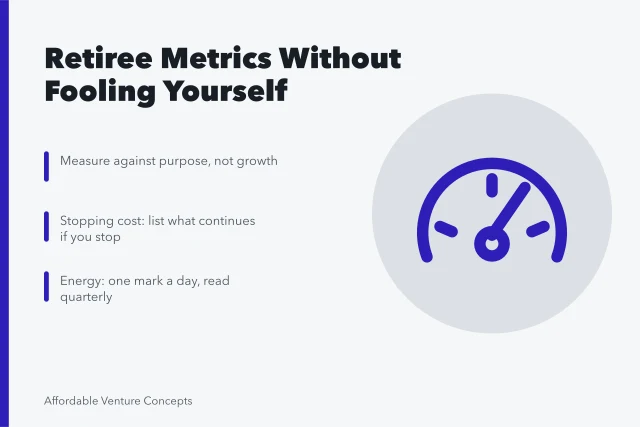
- The recurring good move was to give up growth in exchange for the ability to stop.
- The recurring bad move was accepting a commitment that outlived the circumstances that made it comfortable.
When the point was reliable income
Case A, the surveyor who sold a defined report. Rather than offer his time, he defined one report at a fixed price with a fixed scope. Reasoning: a defined piece of work is easier to sell, easier to price and easier to deliver in a predictable number of days, and the skill-based guide treats that shift as the rung most experienced people skip.
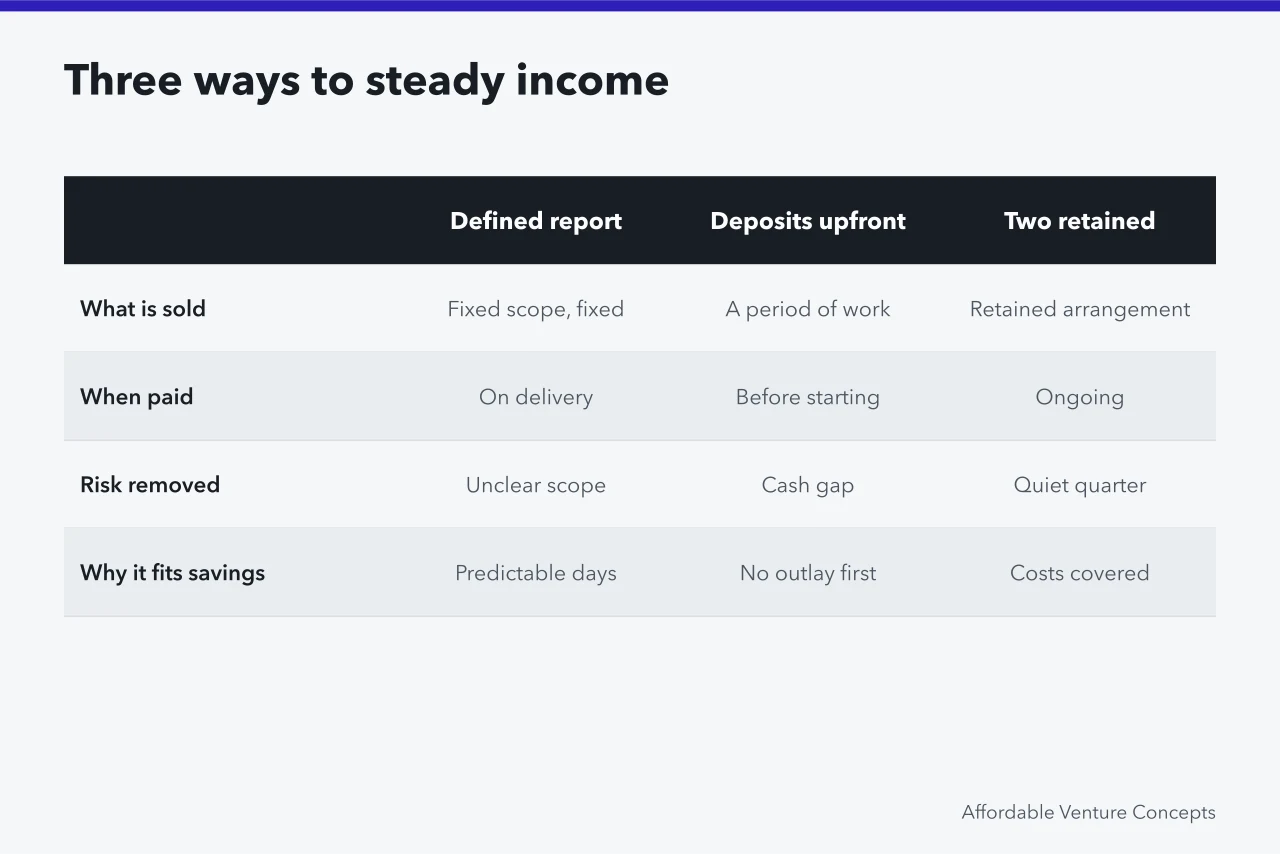
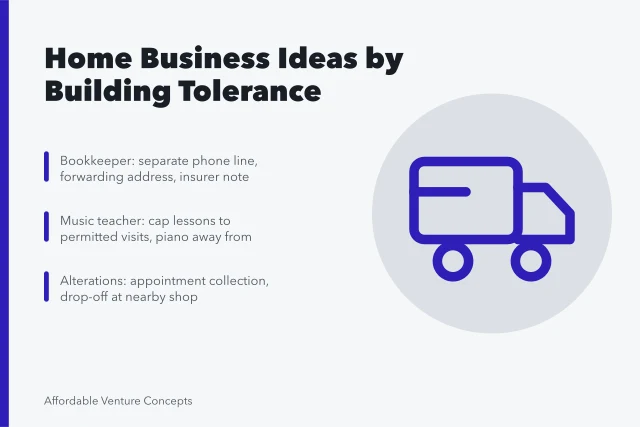
Case B, the bookkeeper who took deposits. Payment was taken in advance for a period of work rather than invoiced afterwards. Reasoning: being paid before spending removes the cash gap entirely, which matters more when the reserve behind the venture is savings.
Case C, the trainer who kept two clients as a floor. Two retained arrangements covered the fixed costs, and everything else was optional. Reasoning: a floor turns a quiet quarter into a quiet quarter rather than a crisis.
When the point was occupation and structure
Case D, the woodworker who capped the order book. Demand exceeded what he wanted to do. He raised prices and kept the same number of commissions. Reasoning: when the point is the work rather than the income, growth is a cost, and price is the lever that keeps the volume where you want it.
Case E, the volunteer coordinator who charged anyway. Work she would have done for nothing was priced, modestly, because unpaid arrangements had previously drifted into demands. Reasoning: a price sets expectations on both sides, and it is easier to be generous from a stated position than from no position.
When the point was contact with people
Case F, the tutor who chose the inefficient version. Group sessions in a hired room paid less per hour than online individual work and were the reason he was doing it. Reasoning: efficiency is only a virtue when it serves the purpose, and here it did not.
Case G, the repair service that stayed local. Deliberately restricted to a small area so that customers were neighbors rather than addresses. Reasoning: the local service pillar makes the economic case for a tight radius; here the same decision was taken for a different reason and produced the same result.
When the point was to build something to hand on
Case H, the agency that wrote everything down. From the first month, every process was documented well enough for somebody else to follow. It slowed the start considerably. Reasoning: a venture that only exists in one person's head cannot be handed on, sold, or paused, and documentation is the only thing that changes that.
Case I, the name that was not a person's name. The business was deliberately not named after its founder. Reasoning: a business named after you is difficult to transfer and impossible to outlive, and the decision costs nothing at the start and a great deal later.
The one that went wrong
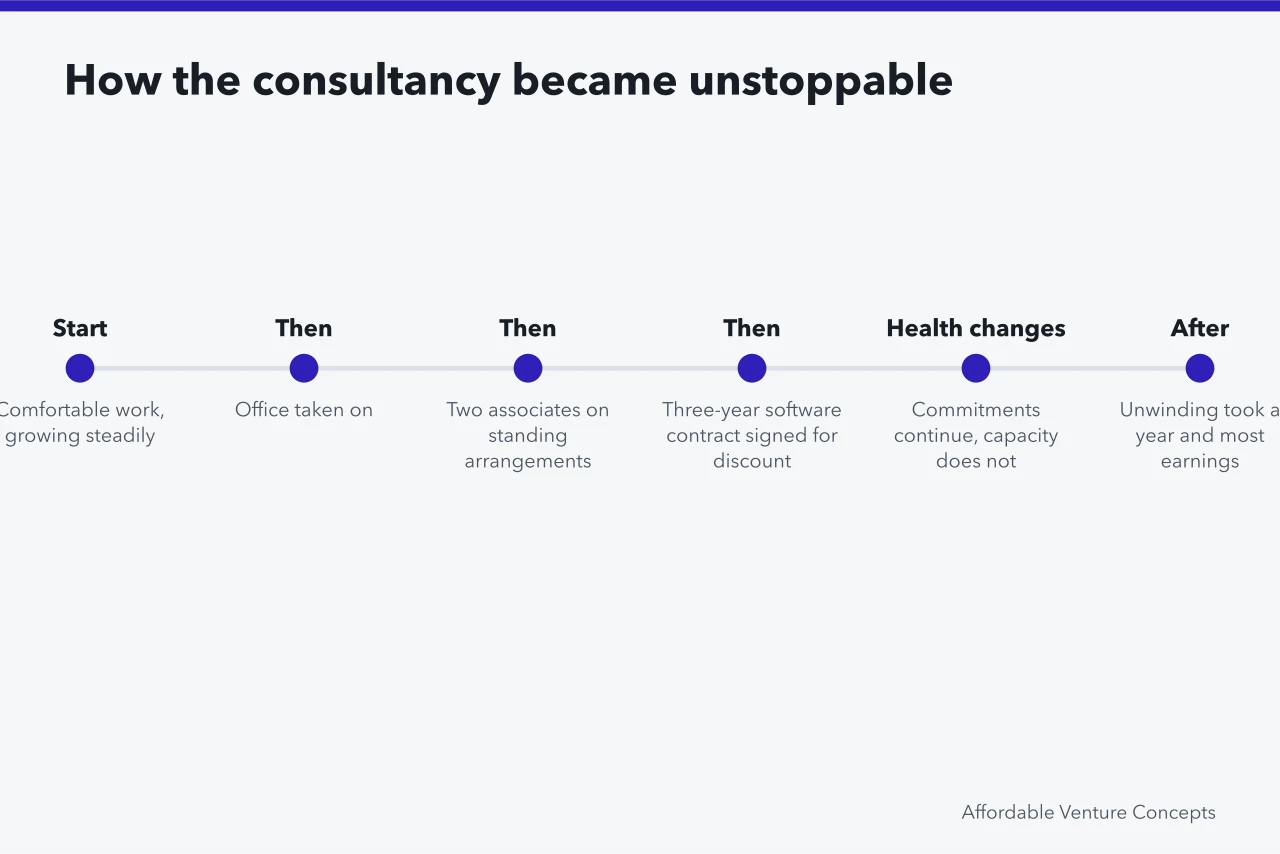
Case J, the consultancy that could not be stopped. Comfortable work, growing steadily, so an office was taken, two associates were brought on standing arrangements, and a three-year software contract was signed for the discount. When health changed, the commitments continued and the capacity did not. Unwinding took a year and most of what had been earned. Reasoning: every one of those decisions was reasonable in isolation, and together they removed the ability to stop. The startup budget guide treats each of them as irreversible spending, which is the category to delay longest. An ending designed at the start would have caught all three.
What the ten share
The cases divide cleanly. Where the purpose was named first, the decisions follow from it and look obvious in hindsight. Where it was not, the venture drifted toward growth by default, because growth is what everybody assumes a business is for.
Two practical notes recur. First, free local help exists in most countries for exactly this stage, and the SBA's directory of local assistance for small businesses is one country's version of it. The equivalent elsewhere is usually a public body rather than a private adviser.
Second, ventures sold as ready-made opportunities are marketed heavily to people who have just left work and have savings, and they are frequently recruitment structures rather than businesses.
The FTC's consumer guidance on multi-level marketing and pyramid schemes sets out the pattern: a fee to join, stock to buy, income that depends on recruiting rather than on customers, and pressure to decide today. A real venture has customers who are not also members.
Common questions
Are any of these real businesses?
No. They are composites built to carry one decision each, and the reasoning is the part meant to transfer.
Why no figures at all?
Because a figure for an invented business in no particular place would be fiction, and invented figures are the most quoted part of any article. Price your own version from local evidence.
Which case applies most widely?
The first three. Most ventures started after a career are service ventures, and the decisions that matter are about scope, payment timing and having a floor.