Costs
Part of Retirement rules quietly decide what a retirees' venture can risk
7 plain facts about ideas for retirees framework
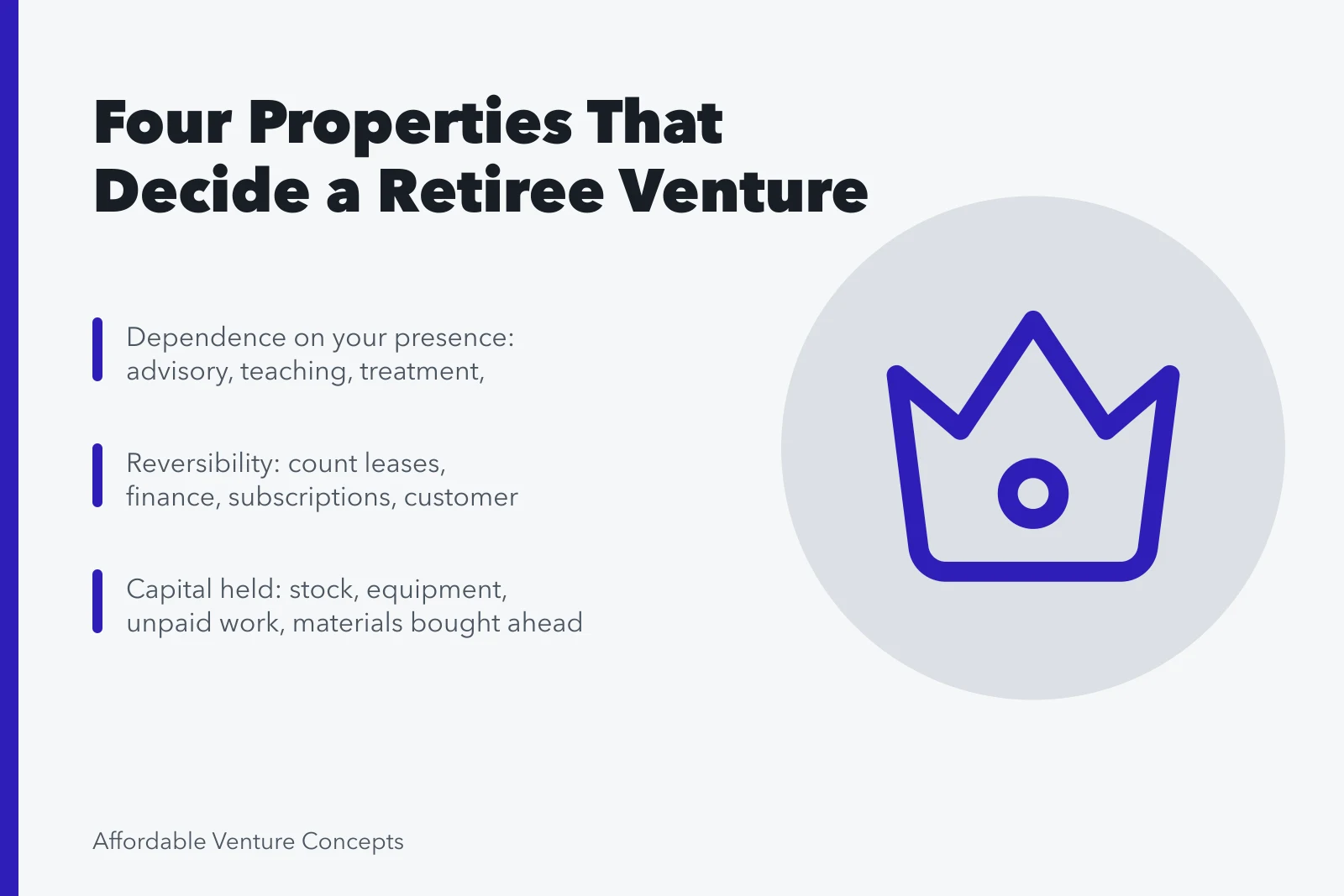
Ideas for retirees framework built on four properties: dependence on you, reversibility, capital held and whether the venture can be handed on or stopped.
Comparing ventures by trade tells you very little at this stage. What separates a venture that fits a life after a career from one that quietly takes it over is four structural properties, none of which appears in a description of what the business sells.
The retirees pillar works through what you want the venture to produce. This page sets out the four properties, shows how to place an idea on each, and reads the shapes. There is nothing to score and nothing to add up.
What to take away
- Four properties decide how a venture will feel to runhow much it depends on you being present, how quickly it can be stopped, how much capital it holds, and whether anybody else could take it over.
- The properties are chosen because each one determines what happens when your circumstances change, which is the risk that matters most here.
- A venture can be redesigned against all four in the first year. After the first year, changing them costs money and relationships.
Property one: dependence on your presence
Some ventures cannot happen without you in the room. Advisory work, teaching, treatment, inspection, anything sold on your judgment or your hands. Others run on things you made earlier: stock, a product, a documented process, work that other people deliver.
High dependence is not a fault. It is the fastest thing to start, it needs almost no capital, and it uses the advantage a career leaves behind. It ties the income to your availability, which is the property to be honest about if that availability may change.
Placing an idea: ask what the venture earns in a month when you do nothing. If the answer is nothing at all, dependence is total, and every other decision should account for that.
Property two: reversibility
How long would it take to stop, and what would stopping cost? Count everything that continues: customer commitments, standing arrangements, leases, finance, subscriptions, and any promise somebody is relying on.
A venture that can be wound down in a month has a quality that is difficult to value and easy to lose. The startup budget guide treats irreversible spending as the category to delay longest, and this framework treats it as the property to protect deliberately, because the reasons to stop tend to arrive without notice.
Placing an idea: write the list of things that continue if you sell nothing next month. That list is your reversibility, measured honestly.
Property three: capital held
How much money is tied up inside the business at any moment, in stock, equipment, work delivered but not yet paid for, or materials bought ahead?
This matters more when the money is savings than when it is salary, because savings are not replaced. The SBA's page on estimating what it costs to open and to keep going separates the two kinds of spending, and the second kind, the money the venture holds continuously, is the one that quietly grows.
Placing an idea: ask what the largest amount is that would ever be inside the business at once, and whether losing it entirely would change how you live.
Property four: can anybody else run it?
Could someone take this over for a month, or permanently, from written instructions? The honest answer for most new ventures is no, and that is fine until you want it to be otherwise.
This property decides whether you end up with something to hand on or sell. It costs real effort: written processes, a name independent of yours, customers who belong to the business, not you, and records someone else can read.
The skill-based guide treats that as the rung above selling your own time.
It also has a legal and tax dimension: a structure that can be transferred is not always the one that is simplest to start.
The IRS summary of how different business structures work shows the kinds of difference involved.
Placing an idea: ask whether a competent stranger with your notes could serve a customer next week.
Reading the four together
What it feels like
- Dependent, reversible, light, not transferable
- Consulting, teaching, advisory work, most service ventures
- Dependent, hard to reverse, heavy
- A trade with premises, equipment and staff
- Not dependent, reversible, light
- Products, stock, licensed work, documented services
- Not dependent, heavy, transferable
- Something built to sell or hand on
What to watch
- Dependent, reversible, light, not transferable
- Income stops exactly when you do, so decide how much of your income should depend on it
- Dependent, hard to reverse, heavy
- The hardest shape to leave; only worth entering deliberately
- Not dependent, reversible, light
- Slower to start and the only shape that survives your absence
- Not dependent, heavy, transferable
- A different project, requiring systems and other people from the start
The first row is where most ventures started after a career actually sit, and it is a sound place to be. The mistake is drifting into the second row one commitment at a time.
Four venture shapes compared
Dependent, reversible, light
- Example
- Consulting, teaching
- Income if you stop
- Stops at once
- Capital held
- Light
- Transferable
- No
- Watch
- Income depends on you
Dependent, hard to reverse, heavy
- Example
- Trade with premises
- Income if you stop
- Continues, costly
- Capital held
- Heavy
- Transferable
- No
- Watch
- Hardest to leave
Not dependent, reversible, light
- Example
- Products, stock
- Income if you stop
- Survives absence
- Capital held
- Light
- Transferable
- Partly
- Watch
- Slower to start
Not dependent, heavy, transferable
- Example
- Built to sell
- Income if you stop
- Runs without you
- Capital held
- Heavy
- Transferable
- Yes
- Watch
- Needs systems, people
Changing the shape on purpose
Each property can move, and the first year is cheap; dependence falls when you document the work. Reversibility rises when you refuse long terms and rent, not buy, and capital held falls when you take deposits, keep less stock, and invoice sooner.
The profit model guide treats this under cash timing; transferability rises only through documentation, and nothing else substitutes.
None of those requires a different trade. They are choices about how the same work is packaged.
When the framework says stop
If an idea depends heavily on you, is hard to reverse, and needs significant capital, it fits poorly with a stage of life where circumstances change quickly, however good the idea is.
Do not abandon it. Find a version that gives up one of the three, and naming what you want from the venture usually shows which one.
Common questions
Is a dependent venture a bad venture?
No. It is the fastest to start, uses your experience directly, and is what most advisory and teaching work is. It simply should not be the only thing an income depends on if your availability might change.
How do I make something transferable later?
By writing down how the work is done, from the beginning, in a form somebody else could follow. There is no shortcut, and retrofitting it is much harder than starting it.
Which property should I protect hardest?
Reversibility. It is the one that costs nothing to keep and everything to recover, and it is the one that turns a change of circumstances into an inconvenience rather than a crisis.