Rules
Part of Retirement rules quietly decide what a retirees' venture can risk
Ideas for retirees mistakes, and the fixes that hold
Ideas for retirees mistakes that cost savings, freedom or health, with what each one feels like from the inside and the correction to make early.
The mistakes below are specific to starting something after a career. Each has a reason it feels sensible, and several are made by people who ran large organizations competently, because the skills that worked inside one do not all transfer to a venture of one. For each there is the cost and the correction.
What to take away
- The expensive mistakes here involve savings and commitments, not the choice of idea.
- Several come from applying the habits of a large organization to a business with no colleagues and no reserves.
- People who have just left work and hold savings are targeted deliberately, and the warning signs do not change.
1. Not naming what the venture is for
Why it feels sensible: the idea is the interesting part, and the purpose seems obvious.
What it costs: a venture optimized for growth when you wanted occupation, or for enjoyment when you needed reliable income. Every later decision inherits the confusion.
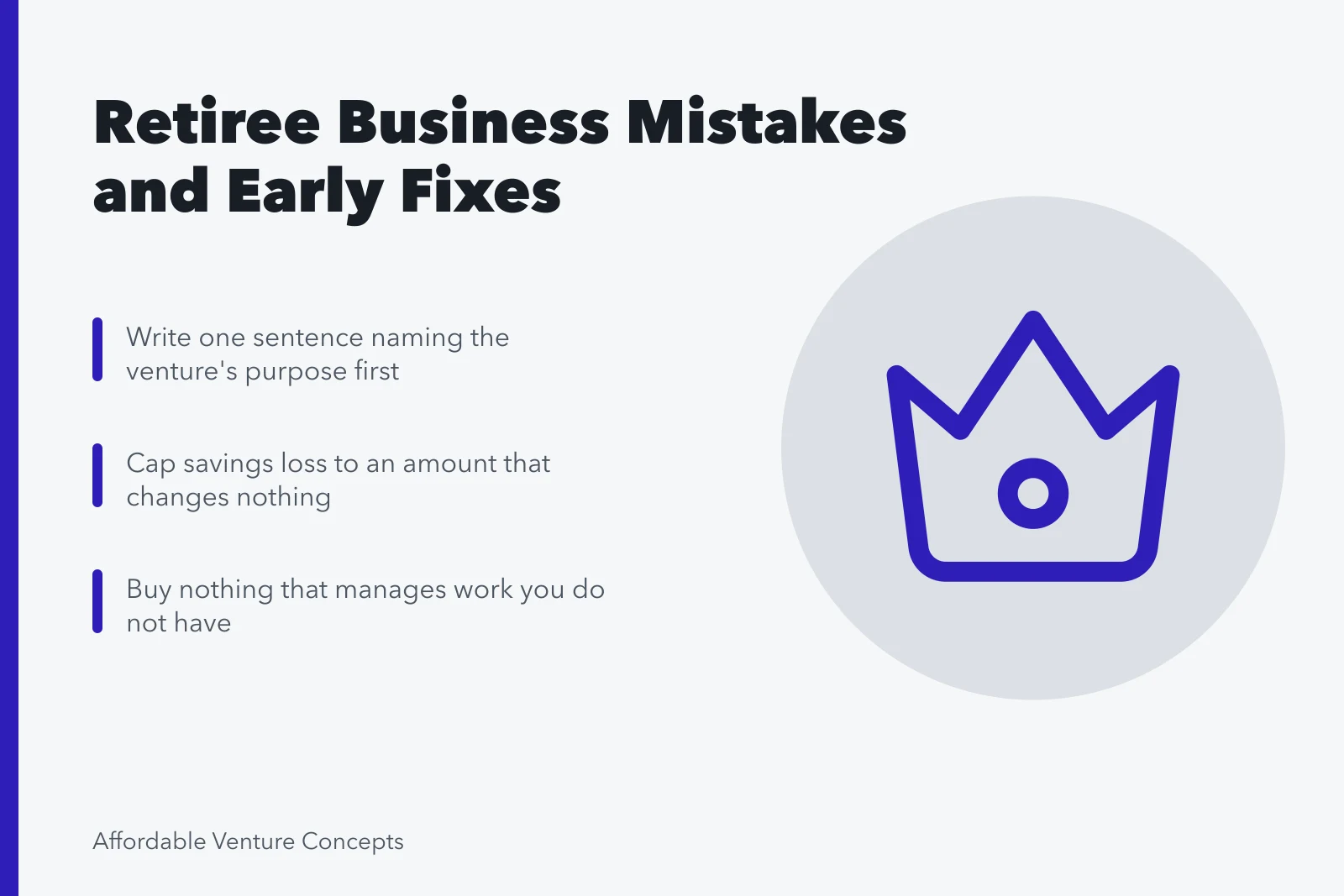
Correction: write one sentence before anything else. The retirees pillar works through what different purposes imply, and the differences are large.
2. Funding it from savings without a limit
Why it feels sensible: the money is there, it is yours, and the venture is going to work.
Set a savings loss limit
- Decide amount you could lose entirely
- Write it down before spending
- Put the rest beyond the venture's reach
- Never spend savings that cannot be earned again
What it costs: savings that cannot be earned again, spent gradually in amounts that never felt like a decision.
Correction: decide in advance the amount you could lose entirely without changing how you live, write it down, and put the rest beyond the venture's reach.
3. Building the organization you used to work in
Why it feels sensible: you know how a proper business is set up, and it feels careless not to do it properly.
What it costs: structure, systems, an office and roles, all bought before there is any work for them to organize. A venture of one needs almost none of it.
Correction: buy nothing that manages work you do not yet have. The startup budget guide separates the cost of being ready from the cost of staying alive, and this mistake spends everything on the first.
4. Pricing from your old salary
Why it feels sensible: it is the only number you have, so it becomes the reference point.
What it costs: a price that is either far too high, because a buyer compares against what the work is worth rather than what you used to be paid, or far too low, because work that feels easy to you is priced as if it were easy for anyone.
Correction: price the piece of work, and expect an organization to compare it against what doing it internally would cost.
5. Signing away the ability to stop
Why it feels sensible: the discount for a longer term is real, and the work is going well.
Long-term vs monthly commitments
Long-term commitment
- Exit
- Locked in
- Equipment
- Leased or bought
- Leases
- Signed
- Certainty
- Assumed stable
Monthly terms
- Exit
- Can stop monthly
- Equipment
- Rented
- Leases
- None
- Certainty
- Matches real certainty
What it costs: commitments that continue when circumstances change, and circumstances change with less notice at this stage than at any other.
Correction: monthly terms, rented equipment, no leases, and a standing rule against anything with a term longer than your certainty.
6. Working for a former employer without written terms
Why it feels sensible: you know these people, you trust them, and asking for a contract feels like distrust.
Written terms for former employers
- Written scope of work
- Price stated in writing
- Payment term agreed
- Apply to everyone including friends
- Check non-compete and confidentiality obligations
What it costs: scope that expands, payment that slows, and no document to point at. Familiarity is what makes this one hard to correct later. One former employer providing most of the income is an employment arrangement without the protections, which the profit model guide treats as concentration risk.
Correction: a written scope, a price and a payment term, for everyone, including friends. Check any non-compete or confidentiality obligations from your old role before approaching former customers.
7. Ignoring what happens to cover and entitlements
Why it feels sensible: the venture is small, and the arrangements you have seem settled.
Check cover before first payment
- Identify each body that pays or covers you
- Ask about tax, entitlements and health cover
- In the US, start with Medicare basics
- Get the answer in writing where possible
What it costs: an unpleasant discovery about tax, an entitlement, or health cover, made after income has already arrived. The rules differ everywhere and only the paying body can answer for your case. In the United States, for instance, the introduction to how Medicare coverage works is the place to start rather than a forum, and the equivalent elsewhere is whichever body administers the scheme you are in.
Correction: ask each body that pays you or covers you, before the first payment. Get the answer in writing where you can.
8. Letting the venture grow past what you wanted
Why it feels sensible: demand is flattering, turning work down feels wasteful, and growth is what businesses are supposed to do.
What it costs: the freedom that was the point. A venture that has quietly become a job with obligations is harder to leave than the job you left.
Correction: raise the price and keep the volume. If the purpose was occupation rather than income, growth is a cost and price is the instrument that controls it. Raising it is easier when you sell a defined piece of work rather than hours, which is what the skill-based guide argues for throughout.
9. Taking the opportunity that found you
Why it feels sensible: it arrived through someone you know, it suits your experience, and it needs no learning.
Screen a ready-made opportunity
- Ask where the money comes from
- Ask what happens to yours if you stop
- Get the terms in writing before paying
- Watch for a fee to join
- Watch for pressure to decide today
- Watch for income described as a lifestyle
What it costs: a joining fee, stock you must buy, and a network spent on recruiting. Ready-made opportunities are marketed heavily to people who have just stopped working and hold savings. Two structures recur: income that comes from recruiting rather than from customers, and a product that is a course about selling the course. General guidance on recognizing and reporting scams is worth reading before rather than after, and where an offer is sold as a way to earn, the FTC's Business Opportunity Rule requires a seller in the United States to hand over a disclosure document before you pay.
Correction: ask where the money comes from, what happens to yours if you stop, and for the terms in writing before paying anything. Warning signs are consistent: a fee to join, pressure to decide today, income described as a lifestyle, and someone above you who benefits from your yes.
What connects them
Most of these are about protecting two things that are harder to replace now than they were at twenty-five: savings and freedom. A venture that risks a defined amount, keeps its commitments short, and can be stopped in a month can be run for years without anxiety.
One that risks the reserve and removes the exit is a different proposition, whatever it sells, and the part-time pillar has a useful version of the same discipline for anyone easing out of work rather than stopping.
Common questions
Which mistake costs the most?
Number two, in money, because savings do not come back. Number five, in everything else, because it removes the option to correct the others.
Is it a mistake to keep the venture small?
No. Small, stoppable and enjoyable is a legitimate design. It becomes a mistake only if you needed income the venture is too small to produce.
How do I check an opportunity somebody I trust has recommended?
The same way as any other, and their recommendation is not evidence. Ask where the revenue originates, and whether they benefit from your decision.