Reviews
How much does a student side venture cost after graduation?
Prices out what a student side venture costs after graduation, from lapsed .edu tools to state filing fees, insurance, processing, and self-employment tax.
What to take away
- Campus subsidies end quickly. A .edu email, student software plans, and education cloud credits turn into paid seats within weeks of graduation.
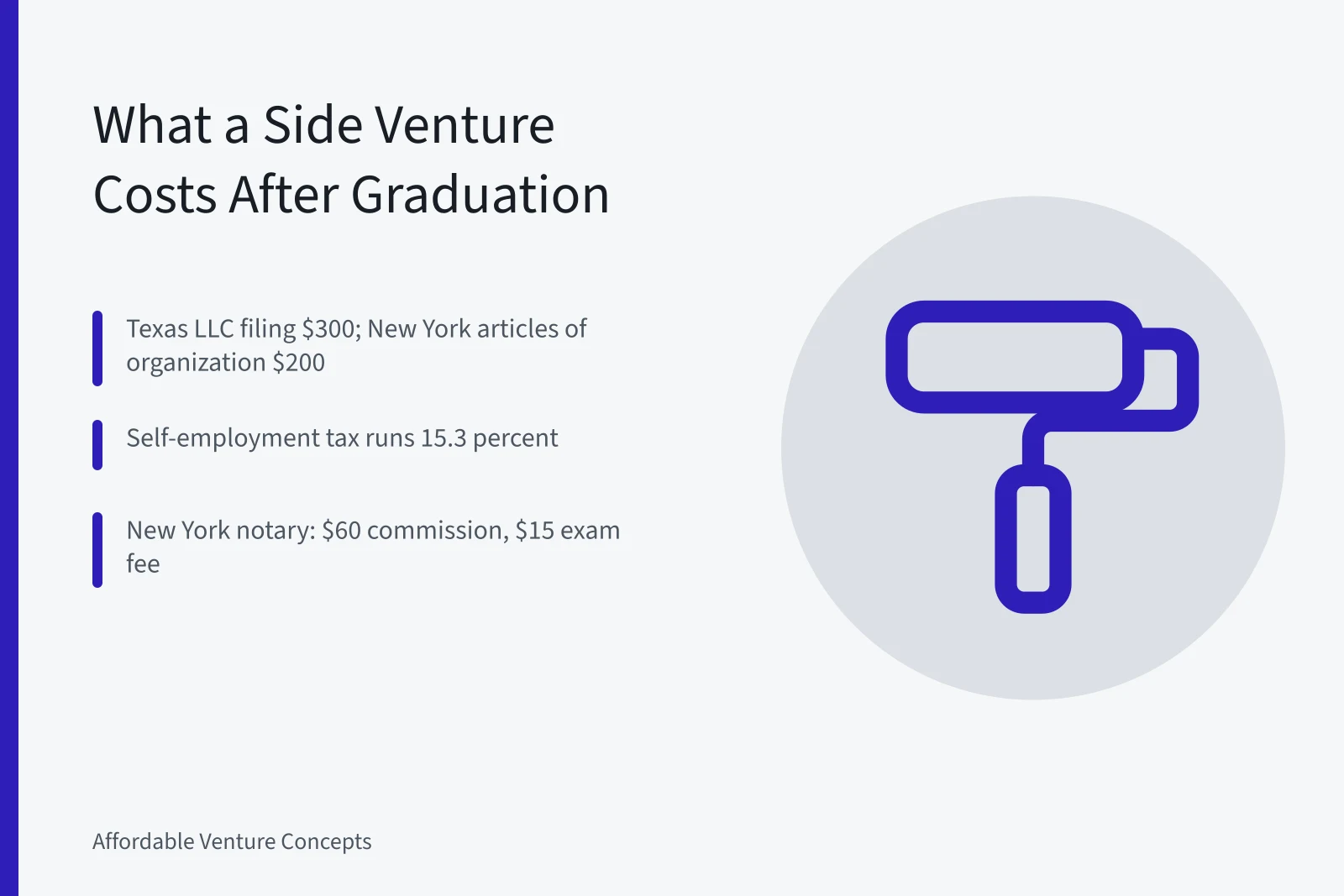
- Formation is a one-time cost. Texas charges $300 to file an LLC certificate of formation and New York charges $200 for articles of organization. Some states charge under $100.
- Recurring costs form the real student venture budget breakdown: software seats, bookkeeping, insurance, card processing, and transport.
- Self-employment tax of 15.3 percent applies to net earnings, so hold back a share of every payment.
- Affordable business ideas for students stay affordable when monthly cost sits below monthly revenue, even in a slow month.
The campus subsidy that ends at graduation
While you are enrolled, the venture runs partly on someone else's budget. Google Workspace for Education, Microsoft 365 Education, Notion's student plan, the GitHub Student Developer Pack, JetBrains student licenses, and Adobe student pricing all depend on proof of enrollment.
Verification lapses. Access closes on a date you do not control.
What a student side venture costs after graduation is close to what the same work costs any small business. The campus card is simply gone.
If you are still choosing what to sell, the what people ask about student ideas page settles permission, calendar, and ownership questions before money enters the picture.
Post-graduation side business ideas that need a storefront or a commercial kitchen should wait until revenue exists to carry them.
The post-graduation cost table
Student version
- Email and documents
- .edu Google or Microsoft account, no charge
- Design and photo work
- Student plan with enrollment proof
- Hosting and cloud
- Education credits, capped
- Bookkeeping
- Spreadsheet or free student tier
- Insurance
- Family policy or nothing
- Card payments
- Often unused
After graduation
- Email and documents
- Paid seat per user, billed monthly
- Design and photo work
- Standard plan at list price
- Hosting and cloud
- Pay-as-you-go metering
- Bookkeeping
- Paid tier once invoice count passes the limit
- Insurance
- General liability priced by revenue
- Card payments
- About 2.9 percent plus 30 cents per charge
The bottom row is the one graduates feel first. Stripe and Square take their cut on every payment before the money reaches the bank.
What the first ninety days cost
- Choose a structure. A sole proprietorship costs nothing to register. An LLC adds a state filing fee and, in some states, an annual report.
- Register the business and request a free EIN from the IRS. The SBA registration guide lists the state-level steps.
- Open a separate bank account. Many banks waive the monthly fee at low transaction counts.
- Replace campus tools one at a time as each verification lapses, rather than paying for a full stack on day one.
- Price the first job to cover a full month of fixed cost, not just the labor hour.
Part-time business startup costs stay low when the first paying customer arrives before the first annual subscription renews.
Treat the total as startup money comes in four kinds, not one lump sum. A monthly seat is reversible. A state filing fee is not.
Example: a mobile notary started in a dorm room
New York lists a $60 fee for a four-year notary commission and a $15 exam fee. The state licensing page covers eligibility, renewal, and what a notary may charge per signature.
Supplies come from any office retailer: a stamp, a journal, and a receipt book. None of it depends on a campus address.
Running cost is where the budget changes. Travel, printing, a phone plan, and the tool stack now come out of your pocket. The state caps the fee per signature, so income depends on volume and on signing work with title companies.
Moving to a cheaper tool stack
Graduation is the right moment to re-shop every subscription. Zoho Mail, Google Workspace Business Starter, and Microsoft 365 Business Basic cover email and documents at business tier prices.
LibreOffice and OnlyOffice replace office suites. GIMP and Photopea replace photo editors. Wave keeps simple solo books at no charge. Canva's free tier handles most social graphics.
Low-cost business ideas for students keep working because the owner holds the file, the customer list, and the equipment.
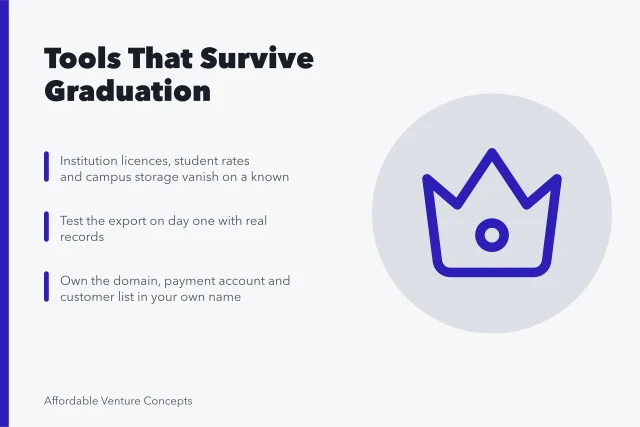
Check export before you switch. A tool that will not release your files in a usable format is a lock-in with a monthly bill.
Compare candidates against the student venture tools that survive graduation list before you commit to an annual seat.
Tax and registration costs that scale with revenue
Self-employment tax of 15.3 percent covers Social Security and Medicare on net earnings. Quarterly estimated payments keep the year from ending with one large bill.
The IRS self-employed tax center lists the forms, deadlines, and record keeping expectations.
Business structure changes the paperwork. A sole proprietor files Schedule C with a personal return. An LLC in many states owes an annual report fee on top of the filing fee.
Keep receipts for software, mileage, and supplies. Ordinary and necessary business expenses reduce taxable profit.
Where the venture actually lives
Rent often disappears after graduation because the work happens at home. That moves cost into storage, permits, and insurance instead.
A home-based idea with staying power fits the space, the permit file, and the hours a household already runs on. Test that fit before signing a lease.
Common questions
Does a side venture cost more after graduation than during college?
For tools, yes. Student pricing ends and standard pricing starts. For total cost, it depends on whether campus housing and meal plans were already carrying part of the work.
Do I need an LLC to start?
No. A sole proprietorship needs no filing fee. An LLC adds liability protection, a state fee, and in some states a separate annual report.
What is the smallest monthly budget that keeps a venture alive?
Domain, email, and a payment processor. Everything else can wait until revenue exists to cover it.
Can I write off the tools and the travel?
Ordinary and necessary business expenses reduce taxable profit. Records matter more than the category, so keep receipts from the first purchase.