Reviews
Student venture budget rules: what the calendar does to your costs
How to map the academic calendar onto a student venture budget: which tools and funding sources to drop at each term boundary, and what to keep.
What to take away
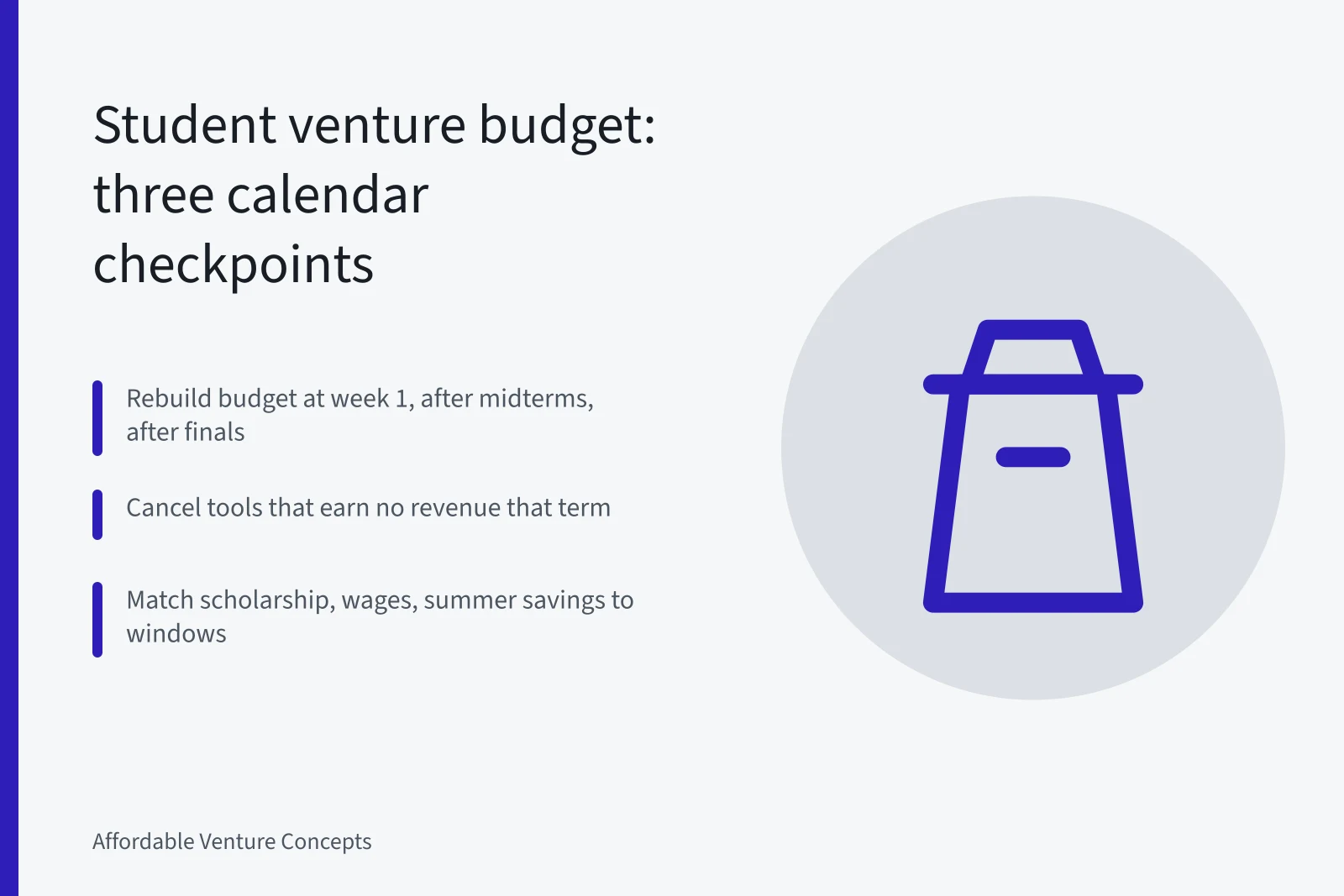
- Rebuild the student venture budget at three calendar pointsthe first week of classes, the week after midterms, and the week final exams end.
- At each boundary, cancel every tool that does not earn revenue that term. Renew only what a paying client or a graded launch needs.
- Match funding to the calendar. Scholarship refunds, summer savings, and part-time wages arrive on different dates, so spend each one inside its own window.
- Keep one page listing every tool, its renewal date, and a written keep or drop decision.
- A venture budget that ignores the academic calendar usually runs out of cash before the term does.
The academic calendar as a budget clock
Most student costs arrive in the first two weeks: books, lab fees, a laptop, parking. Venture costs often arrive later, when a project needs a paid tool, a domain, or a license.
That mismatch is the real budget problem. The cash lands in a lump at the start of term. The venture spends it slowly and then stalls near finals.
Build the plan around the calendar instead of the month. The rest of the rules follow from that one change.
Which tools survive each term boundary
| Term point | Cost that peaks | Tool decision | Cash move |
|---|---|---|---|
| Week 1 | Books and software bundles | Keep tools tied to a live client | Move refund money into a separate account |
| Midterms | Printing, tutoring, extra data | Drop free trials that turned paid | Check every renewal date |
| Finals | Food delivery, late transport | Pause monthly subscriptions | Write next term's budget |
| Summer | Full price software, co-working | Cancel campus-only accounts | Send savings to the fall |
Two rules cover most cases. First, a tool stays only if a customer, a contract, or a graded deliverable depends on it this term. Second, any subscription without a renewal date you can name gets cancelled.
Use a checklist at each boundary:
- List every paid tool and its renewal date.
- Mark each one as earns revenue, supports a grade, or neither.
- Cancel the neither column before the next billing cycle.
- Move the freed money to a separate account.
Funding sources and their drop dates
Startup money comes in four kinds, not one lump, and each kind has its own expiry. Startup money comes in four kinds explains the reversibility test and how to work out your own floor figure.
Scholarship refunds arrive once per term. Spend them on costs that produce income before the next refund date.
Part-time wages arrive weekly or biweekly. These fit subscription costs because you can stop them at any pay period.
Family gifts and summer savings arrive in larger, less predictable amounts. Use them for one-time purchases, not recurring fees. When you register the venture, the SBA guide on choosing a business structure shows how entity choice changes your filing and deduction options.
Track every tool payment in one place. The IRS guidance on deducting business expenses applies to subscriptions that serve the venture.
Tools that outlast graduation
Student venture tools that survive both graduation and a budget cut share three traits: you own the account, you can export the data, and the price does not depend on a campus email address. Student venture tools that outlast graduation compares those traits directly.
Check each tool against the account closure problem. A student discount that ends when the .edu address ends is a cost increase waiting for a date. Budget that increase now, in the term where it lands.
Where home-based rules change the plan
If the venture runs from a dorm, an apartment, or a family home, the calendar still controls cash, but the fixed costs differ. Before you sign a lease or buy equipment, home-based ideas for 2027 explains how the building, the permit file, and the insurance policy shape what you can run from home.
Rent, utilities, and insurance do not pause when classes start. Treat them as a floor the venture must cover every month, not a cost you can cancel at a term boundary.
Example: rebuilding a budget after midterms
Rebuilding a budget after midterms
- Open the tool list and mark every renewal date inside the next six weeks.
- Move the next term's tuition refund into a separate account, away from the card you use for food.
- Cancel every tool marked neither, then write the saved amount on the budget as income.
- Before buying a laptop or a printer, check the SBA guide on buying assets and equipment. Depreciation and resale value change the real cost.
- Recheck the plan against the questions students ask most, including student questions answered plainly.